November 28th, 2011 02:35pm Paula

The road I live just up from, Albaicin
It is raining in Granada. Water runs off tiled roofs and splatters fatly on the cobblestones. Flamenco guitar from a neighbourhood show drifts through the wrought iron window bars. I’m sitting on my couch, drinking a bottle of cheap red and watching the world pass by my ground floor window.
In the Albaicin, where I live, everyone is interesting. Or at least they look it. The style of the day is arty hippy, all loose cotton trousers bought from the Moroccan stallholders that have set up a second home here. Dreadlocks,

walking down from my flat
 handmade silver jewellery, and flat soled leather babouche shoes to walk comfortably up the steep stone alleyways. The smell of dope hangs permanently in the air, and everyone seems to have a dog. Walking through the Albaicin is a constant exercise in looking down – there is dog crap every metre. Strange, though, how it doesn’t impinge on the charm of the place. In the same moment that you step over crap, a pomegranate tree hangs over a whitewashed wall, and charms you completely with its delicate leaves and sensual red fruit.
Today I walked up the Sacromonte hill. Since I never read guidebooks – I am strangely phobic about them, worrying they will somehow steal the magic of discovery – I just followed my nose and rambled.
I’ve been somewhat confused about the Sacromonte. The facts I knew from unavoidable tourist literature: The Sacromonte is home to the local gitano (gypsy) culture, dating back to the fifteenth century; many dwellings on the hillside are caves; and it’s the place where tourists looking for a flamenco show are shamelessly fleeced for their last cent, whilst watching mediocre performances.
For the two weeks I’ve had my flat in the Albaicin, I’ve daily looked over the Sacromonte hill, wondering how and when I should approach it. Whilst fascinated by the history and culture, instinct warned me that it is a barrio best saved for a date when my Spanish is fluent and, perhaps, my connections more solid.
But this morning I wandered up into the high Albaicin, and found a square I never have before, with tiny restaurants staffed by gitanos. The clientele were all local, the food was good and cheap, and the music was fantastic. Buoyed by a wonderfully cheap lunch that included a glass of decent wine, I set off, with the vague intention of wandering through the Sacromonte in the safety of broad daylight.
I crossed the road that separates the Albaicin from the Sacromonte barrio, and began to climb. At three in the afternoon, the alleyways were deserted. Cooking smells wafted through the air, but doors and windows were firmly shut. Graffiti adorned every blank concrete wall, of which there were far more than in the Albaicin. As I climbed higher, the houses tapered off to

winding up into the Sacromonte
become ramshackle affairs built into the hill, their front boundary demarcated by a couple of old gates wired together. The doorway was usually no more than a curtain blowing in front of a darkened opening. Outside a jumble of old pots and torn armchairs suggested that most of the cooking is done on a camp stove or fire outside the cave.
It was hard to believe that anyone actually lived there. The paths, dirt by now, cobblestoned alleyways far below, became increasingly steep and fragile, loose dirt and stone crumbling underfoot. The detritus in front of the unassuming curtained openings was both poignant and haphazard – broken bicycles, rusting metal drums, mattresses with bare springs. The same mess that litters a thousand derelict suburbs, only more interesting for existing in front of caves and amongst tall prickly pear plants.
My goal, as such, was the church I could see at the apex of the hill. I was propelled upward by the increasingly breathtaking perspective of the city

Alhambra from the terrace at my flat
below – from up here, even the mighty Alhambra was beneath me, and I could see not only the whole city and the snow of the Sierra Nevada, but the great plains of the Vega stretching out to the sudden peaks of the surrounding mountains.
The lone person I passed on my ascent was a man peeing into the prickly pear. I waited at a diplomatic distance until he’d finished, then approached and asked if I could pass over what appeared to be the roof of his dwelling. Dreadlocked and dishevelled, he grunted his assent, and turned back to his marijuana plants.
The church was closed and lonely, surrounded by a barbed wire fence. On the steps sat an African man, smoking a spliff and chatting up a European girl. We greeted each other and I walked around the back.
There is an ancient stone wall that runs down the Sacromonte hill. Having walked up on one side of it, I now found myself on the other side. The city may as well not have existed. On this side, the landscape rose in sharp hills and deep ravines. A thousand well worn tracks led off in different directions. A plantation of cypress trees rustled in the wind, their hushed sound eerie in the late afternoon.
I walked to the top of a nearby peak and looked down at the Rio Darro, and

behind the sacromonte, in the hills
people meandering along a pretty cobblestoned path far below. They seemed a long way away, another world. Wild thyme grew all over the rough hillside, sending up a heavenly scent.
I thought about walking back the way I had come, but it seemed silly to backtrack. I figured that people on this side must be able to get down to the city somehow, so I started walking downhill.
The first place I encountered was even more ramshackle than those on the ascent. It seemed deserted, although the inhabitants could have been sleeping. The disconcerting part was the lean and rather intimidating Alsation that barked threateningly at me, and nipped at my heels as I passed, uncomfortably close to the property boundary – the path gave me little choice.
A couple of times in the next few minutes I stopped and questioned my choice of direction, thinking that perhaps I should retrace my steps rather than venture further into what was obviously a rather offbeat area. I have never been good at taking my own advice.
The paths wended between fenced off gardens, and amongst tall standing prickly pear. Dogs barked at me from every place, lean mutts with attitude, whose job, I couldn’t help but think, was to guard the sleeping inhabitants within. Eventually I could see a proper road not two hundred metres below, with wandering tourists. Which was fine, except I was high up on a crumbling path, with no discernible route down.
I came close to a place where some kids were playing out front. A young man began walking toward me, and instinctively I clutched my bag more tightly. Then I shook myself off – why do I always expect the worst? He got closer, I said, ‘Hola’, he responded in kind, and all was fine. Meanwhile, the kids sat slackjawed and fascinated as I got closer.
I took a look down the hill and figured it was just a slip and slide to the road, so I took a sharp right and stumbled down. The dogs barked and the kids were calling, undoubtedly to tell me that there was an easier way down, but I’d had enough of walking past silent caves and along tiny paths, with mongrel dogs growling menacingly. I tumbled and stumbled down the hill until I hit the road.
I came out right at the base of the steps to the Sacromonte cave museum, and after a moments deliberation, walked back up and paid my five euros to go in.
I enjoyed it – cave living is nothing new to anyone who has been to Coober Pedy, but I loved the information about the plants and their medicinal purposes, and the area dedicated to flamenco.
I came back down to find the tourist route that I guess all the guidebooks talk about. I walked past the flamenco bars, all shut at that time of day, and could understand how it would be a cavalcade of hustle at night. Whilst the bars of the Sacromonte gave birth to the first incarnations of flamenco in the late eighteenth century, an authentic zambra is no longer something an unsuspecting tourist can wander into. The bars now come prettily packaged and postered, and tour guides lead groups through the winding streets to bars where they are treated to overpriced stage shows. Like anything ‘culturally typical’, in the last twenty years the area has been exploited and homogenised into irrelevance.
The thing I wondered, as I walked, is whether or not the impoverished, eerily closed neighbourhood I had just wandered though, is still a gitano barrio, or just a haven for alternative culture, now? Or are they one and the same? And was I being overly precious for guarding my bag so tightly, and wondering if I was about to be accosted at some low point in the path, or simply realistic?
I can’t help but feel that if I want to find true ‘duende’, the spirit that drives true flamenco, that I am more likely to discover it up those steep, crumbling pathways, behind the snarl of dogs and amongst broken bicycles. But equally, I was surprised at how relieved I was to leave them behind, and emerge into the bland tourist act. Perhaps it is age, but I no longer feel drawn to discover the back alleys.
As I walked home through the utterly civilised alleys of the Albaicin, I passed a very respectable flamenco joint. For eight euros, I could buy a ticket to an intimate night, not a big flamenco restaurant show, but local musos doing their thing.
I lingered for a long time at the door, wondering if I should go in. After walking through the Sacromonte, I almost felt obliged to go and watch, to embrace where I am.
But I saw flamenco, years ago, stamped out in dusty fields by old women as they made their way on the pilgrimage to El Rocio. I know the power of the dance, and I am romantic enough to want to see it again from a personal level, because I have been invited, rather than paying to be part of an anonymous show. I got snobby about it.
Instead I stopped in a local bar, one I really love, although I’ve only been there once before. Every time I walk past, the staff smile and wave, and great music drifts from the open doors.
Tonight I got chatting, in my very basic Spanish, to the people who work there. In the end they bought me a drink and I had great tapas, and we talked for a couple of hours about the city, the Sacromonte, gitano culture and the world in general.
I wandered home in the gathering rain feeling tired and happy, not least because I now have a date to catch up with them all in a couple of days. Given that I’ve only been learning the language for two weeks we actually managed a halfway decent conversation, and they didn’t seem to think I was

my flat
too stupid. I kept thinking I should go somewhere – DO something – and then I thought: all I want to do is go back to my lovely little flat, open a bottle of red, eat some tinned calamari and watch a bit of trash television.
And so here I am. I’m sure that on a Saturday night in Granada, I should be doing a whole lot of other more cultural, worthy things. But you know the nicest thing about living in a place, rather than travelling through it?
You can have a day of very low key adventure, then retire to your own little cave. You can read a book in Spanish with a dictionary close at hand to interpret it. You can eat Spanish cheese and drink wonderfully cheap Spanish red, and check out badly dubbed sitcoms when you get tired.
But best of all – you can open your window, and hear flamenco wail across from the Sacromonte hill, and know that the place you found slightly eerie today, will soon become a friend that you understand.
November 8th, 2011 07:21pm Paula

We all have expectations of what a new life will look like.
Perhaps that’s what makes it hard to uproot oneself. The fear that the reality may not match the dream.
I had secret fears it would happen to me. That the Andalucia I fell in love with when I walked through six years ago was remembered through romantic eyes, by naïve recollections. I wondered if the potent mix of cultural heritage that intrigued and delighted me had perhaps been diluted by thousands of expat Brits moving in, or never as rich in the first place. Deep down, I was haunted by the same fears that haunt all of us: was I doing the right thing? Was it not, perhaps, time to hang up my backpack and accept that life is not an endless adventure?
My dear friend Jeanie and I arrived in Granada in the mid afternoon. By early evening, we were ensconced on a terracotta terrace, bottle (s) firmly within reach, olives and nuts on a plate, gazing in awe at the ancient stone of the Alhambra changing colour in the dusk. An hour later we watched a shining moon beam down upon it like a benediction. In that moment, I think most of my fears evaporated. Those that hadn’t melted away over the coming days.
Slightly worn out after an arrival in Madrid that ended in both of us waltzing into our pension at seven in the morning –complete with roses in hand – having enjoyed rather too much of the local tapas, wine, and gin (don’t ask), we planned on taking it easy the first couple of days in Granada. We were staying in the Albaicin, where I now have a flat. It is the old part of Granada, a Moorish scramble of white washed terraces tumbling down a mountain side. Mostly free of vehicles – apart from the odd suicidal scooter rider - the only sounds come from birds singing to the evening, and strains of flamenco floating from open windows. Cobblestoned alleyways twist and turn beneath overhanging boughs of pomegranates and lemons, delicate moaic patterns winding sinuously through the stone. A snow capped Sierra Nevada stands sentinel over the thousand tiny bars and teterias serving tapas, vino, and mint tea. And above it all, the Alhambra curls in sensual folds, lush gardens and intricate designs, reminding all who pass through her of life’s infinite beauty.
Andalucia is an instant antidote to cynicism and doubt. Its incandescent beauty would melt the ice of a thousand analytical minds. On the second day we were here, somewhat numb after touring the city trying to find a flat, we took refuge with a couple of seriously big mojitos in the sunny forecourt of a local restaurant. It was a holiday, and the Albaicin was humming. Moroccan shopkeepers lured the visiting tourists into their hole in the wall stalls. The hippy students who constitute much of the Albaicin’s population sold their handmade jewellery and played guitar on every corner. Families wandered, couples ate, and Jeanie and I basked in the delicious Andalucian sun. Three women arrived in the middle of the plaza. Two sat on low stools, one with a guitar, one clapping softly. The third placed a wooden board on the cobblestones, and after clapping her hands to find the beat, began to dance. Right there in the middle of the plaza, surrounded by rapt onlookers, she danced and stamped to the music around her, completely absorbed. The crowd grew and grew, loving the passion and sponteneity erupting in the middle of a tiny alleyway on a lazy sunny afternoon. Finally, chest heaving and sweating in the heat, she threw her arms up to finish the flamenco, and the crowd erupted in rapturous applause. Totally unselfconsciously, she went over to the nearest fountain and doused her face and neck in cold water, then packed up and walked away. She reminded me of all the reasons I love this place. She was neither young nor lithe, but, God, she was beautiful. Her smile stretched her whole face and she danced with everything she had. I struggled not to cry as I watched her, caught up in every move of her body. Flamenco is, I think, the most powerful of all dance forms I can imagine.
Two days later, Jeanie and I went to the Alhambra. Walking up the steep hill to its entrance days before, I’d been aware of gradually entering another world as the  gardens became thicker and more lush, the sound of tinkling water and utter peace taking the place of the central traffic. But on the day we actually visited the palaces themselves, it was bucketing down rain, and so we exchewed the long approach for a far more comfortable taxi ride, and entered at the top. The Alhambra has been described, by far better pens than mine, using a variety of voluptuous language. From those who wrote of it in its Moorish beginnings to Washington Irving’s delightful 19th century book (which I am currently loving), it has never ceased to inspire awe and passionate response. The word ‘sensual’, for my money, is the description I like the most.
It is the detail, above all, that I love. Everything is perfectly geometrically positioned, so that at any point, one window lines up with another, one doorway frames a further perspective. Every inch has been worked with curlicued, painstaking pattern and design, every one absorbing and mesmerizing. It is an overwhelming onslaught of sensory delight; around every corner, there is another wonder awaiting, an even greater beauty. From the official palaces to the traditional residence of the Moorish rulers, to the magical tranquility of the Generalife gardens, I wandered, awestruck by every inch. There wasn a nook or cranny that I didn’t feel I couldn’t curl up in and be happy to spend the rest of my days. I was silenced, thrilled, and passionately grateful to be somewhere so stunning.
The very best of it for me is that I can now go and sit in awe as often as I like. I began my language course last  Monday, having fortuitously found a flat the day before I was due to begin. After a few moments of wondering if I’d be living in a hostel for the rest of my stay, on Saturday afternoon I came across the most gorgeous apartment, on the ground floor in the Albaicin bajo – the quietest part of the Albaicin, and exactly where I wanted to be. If the multi roomed layout for a budget price hadn’t already sold me, the view of the Alhambra from the rooftop certainly finished the job. Hard to take, sitting up there with a vino or two.
My course is going incredibly well so far. I am doing five hours of Spanish study a day, five days a week, so it is pretty full on, but seriously enjoyable. There are only two of us in my class, and bizarrely, the other is Australian as well, so we are certainly getting our moneyś worth. Four months of this and I should be yabbering away happily! I guess I will try to update this more regularly now, although I often wonder if I’ve much of anything important to say. I don’t have access to the net at home, so I am not that regular at checking everything.
J ust so you know.
Meantime, I am going to wander back up my little alleyway, have a mint tea and speak some very ordinary Arabic with the patient Moroccan stall holders, and then go and talk to the Alhambra. (This is it from my terrace.)
Which is pretty much my idea of heaven.
I guess that the fears are always there. But when I sit on the terrace and gaze across the valley at the snow topped Sierra Nevada gleaming in the dusk behind the purple walls of the Alhambra, I figure that every one of them is worthwhile. There isn’t an adventure out there that isn’t worth having, and I truly hope I am fortunate enough to have a thousand more.
January 18th, 2011 05:58am Paula

 You may wonder why there are photos of anonymous Andalucians gracing this page. Then again, you may be fortunate enough (ha) to have followed this blog from the beginning – in which case you will know that these pictures featured on this page back in 2004, when Gary and I walked through Andalucia.
Without repeating the entire post (because obviously, you will all go back and read it….), we came across the pilgrimage to El Rocio on our travels. It was one of the most amazing and moving sights I had ever seen – stunning women and glorious men, dressed in the most romantic outfits, playing and singing the stirring sounds of flamenco as they rode to the festival.
Not long afterwards we walked into Seville, and I swore that one day I would return to learn flamenco.
Well, in a round about way, that little mid life crisis has happened sooner rather than later, so I am booked to fly back to Spain in late March – this time to Granada. I am going to spend several weeks learning flamenco and improving my (fairly rubbish) Spanish, then walk the 1000 or so kilometres up the Via Mozarabe and Via de la Plata to Santiago.
I never really thought to do another camino. I liked the route when we walked it, but it seemed such a small part of such a bigger deal, that the idea of walking it in isolation seemed almost a cop out.
But what a change a few years can make. Now, the idea of having two months where I do nothing but walk, seems an almost unimaginable luxury. And to walk through new territory that I know in spirit but not underfoot; to travel through cities and country where the Moors, Jews, and Gypsies created a rich melting pot of learning and music – this seems the greatest gift of them all.
I am writing both fiction and travel memoir on this walk, so I am very much looking forward to completing the second, and researching the first. I am also very excited about learning a dance I have always dreamed of, in the place where gitano culture remains vibrant and strong.
Granada in particular fascinates me. Well, I mean, check this picture out. Who could fail to be fascinated?
In the background the stunning Sierra Nevada rises, and in the city itself lies the Alhambra, the stunning14th century Moorish palace and fortress. It is one of Europe’s smaller cities, but boasts a world famous university, stunning architecture, and a rich musical culture. Not to mention awesome food and wine.
Paula heaven, basically.
I can’t wait. I have begun to plan my footsteps, and train again. I am back in my trusty birkenstocks – although I will need some new ones, since my old Saharan friends look a bit sad, as you can see below.
They still have a prickle left in their base, an old acacia thorn left from Niger. Some of it is also stuck in my foot, although I barely notice it. I leave them there – they remind me that I have miles still to walk, and adventures of the soul still to have.
They also remind me that I am bloody unfit, and need to walk an awful lot before I go anywhere near those Andalucian mountains. Oh, do I ever remember those.
I have only 9 weeks to go. Wasn’t there a movie about that somewhere??
I can’t wait to take you all along on another adventure…it has been far, far too long.
Cheers.
Paula
December 19th, 2010 04:35am Paula

James Price Point
This is the beach at James Price Point, 60 km North of Broome. Some of you may recall that I used to live in the Kimberley. Part of me still calls it home, and always will; I have never ruled out moving back there.
For some years now, Woodside has been campaigning to make James Price Point the location of a $30 billion dollar liquefied natural gas plant. The multinational has been wading its way through the usual obstacles – environmental objections (see the Wilderness Society’s excellent page for details), the concerns of the local indigenous population, led by the magnificent Joseph Roe, and the easily dismissed concerns of various interest groups. Put simply, the company just throws more money at it – and more, and more – and gradually, it is wearing down opposition.
It is easy to see the gas hub as a foregone conclusion.
And I find myself furious.
I wonder how the British people would react if a multinational proposed tearing down Stonehenge to build a gas hub? Imagine the outrage in Italy if someone decided that the Vatican should be dug up to lay a new electricity cable? When the Taliban blasted the buddhist statues in their country to smithereens, it made world wide news.
Why on earth do we not treasure our own country’s riches as much as the wonders of Europe or Asia? I have seen more debate in this country about the degradation of Ankor Wat than is given to the gas hub. These natural resources are OUR treasures.
This week, the Western Australian State Department of State Development released a report recommending that this development goes ahead. Their conclusion barely made a headline. Ask your average Melbourne resident if they have ever heard of either James Price Point, or the planned gas hub, and they will shrug in incomprehension. And yet if you asked the same person what they dream of doing one day – in the top ten will inevitably be a round Australia road trip, where they go to the Kimberley coast line, to bathe in crystal waters, sit on bright white sands, and get lost in nothingness.
Australia has always been politically apathetic. But if we continue to take such encroachments on our natural environment with a dismissive shrug, open another beer, and have a laugh, we are running the very real risk that the beach we like to drink that beer on will be submerged by yet another development. We do not live in a land of infinite resources. We have only few, and they are rapidly being dug up, drilled out, and sold off at a rate that is as frightening as it is horrifying.
I am not going to linger here on the various arguments for and against. They are well documented on various websites, two of which are listed above. Nor am I going to embark on a passionate description of the environmental and cultural impact the gas hub would have, no matter how strongly I may feel about them.
Rather, I am throwing my hat in the ring on a personal level. I am 37 years old, and I have lived the best part of my life in Australia. I love it with a passion that is hard to describe. I love it’s quirky eccentricity, the pubs in the middle of nowhere with weird things hanging from the ceiling and even weirder things drinking at the bar. The way the sun flings out final orange  flames across the pearlescent pink and grey of a northern sky at dusk; watching a storm roll in over the mountains I grew up beneath.
 I love the wildness of the landscape, and the diversity of the populous.
But I am both angry and indignant that the inherent goodness and trust of the Australian people are being taken for granted by both the governments we entrust to safeguard our country and natural resources, and what can only be described as big business interested only in profit at any cost. Brought back to its most fundamental point – at a time when the global community is confronting the very real environmental impact resulting from generations of ‘dig it up and burn it’ philosophy, and mourning the loss of pristine environments worldwide, how can anyone seriously contemplate the wanton destruction of one of the most exceptional coastlines in the world?
There is no possible argument to defend what is nothing more than a blatant disregard for the extraordinary natural gift we are caretakers of. After two centuries of deliberate destruction of the indigenous culture, Australia is openly supporting yet another development that purports to ‘integrate’ whilst doing no more than handing out yet another, ever increasing, ‘sit down’ payment.
I think enough, this time, really is enough.
There are more ways to skin a multinational than simply protesting. I intend to start finding ways to actually fight this gas hub – not, take note, from being built at all, but rather from being built at James Price Point.
Have a look at even the most rudimentary of websites on this issue and the bit that sticks out with glaring horror is the fact that once this hub is built (there are numerous locations on the Pilbara coast further south that are already developed and ready to take the gas hub), it opens the way for a variety of mineral activity in the region. Iron ore, zinc, and bauxite mining are just a few of the resources the area is rich in – and which are dependent on onshore gas processing.
Of particular contempt, therefore, is the spurious claim that locating the hub at James Price point will in some way be more benfecial environmentally than transporting the gas through longer pipelines to a Pilbara location.
All of this might sound like just another environmental rant by a left wing, anti development greenie. I don’t particularly care. What I care about now is galvanising anyone and everyone who is interested in actually making sure this outrage does not go ahead, and coming up with a strategy to fight it.


I remember once years ago, my father telling me that at some point, he had to stop reading about Tibet, because he just found it too distressing. I asked him if he had done anything to protest the issue, and he rolled his eyes and told me he just felt overwhelmed, and that protest was useless. I was only a teenager. I thought at the time how sad it was that someone as smart and sensitive as my father couldn’t do more; I felt sad that he felt so helpless.
I found myself this morning feeling similarly impotent, and wondered what on earth I can possibly do – after all, Missy Higgins, the James Butler trio, and Geoffrey Rush have all been banging the drum on this issue for years.
But I don’t want to just shake my head and feel sad. I think as Australians that we often find it a bit embarassing to really stand up on principle. There is a very British part of us that says, “oh dear, leave that kind of thing to those people in dreadlocks and piercings who are unemployed and have nothing better to do than wave placards.” We seem to consider ourselves a little above protesting.
But I doubt that any European nation would stand by and watch as their national treasures were ripped up and destroyed in the wake of ‘progress’. It is long past time that here in Australia, we recognise that our culture is tied inextricably to the country we live and walk upon. We may not have great architectural icons, or centuries of history built into neat villages. But we have millennia etched upon our natural landscape. We have something that has been desecrated in every other country in the world in the name of progress. We have something that, once lost, can never be replaced.
Our greatest treasure is the very one that is being spent to produce what everybody else already has. We must find a way to stop it continuing, or risk losing what makes Australia unique in the first place.
I plan to do whatever I can.
November 30th, 2010 06:49am Paula

Ever since I got back from my walk, I have seriously struggled to know how to fill my blog. After all – it was begun as a way to share the trek, and for no other real reason. When the trek stopped – well, what now?
My walk was always an intensely personal experience. Adventure as a wider phenomenon, or as a community, interests me very little; the journey of life does, however. I think about writing pieces titled ‘the ten things I learned whilst walking’, etc, but it always feels forced, and trite. Equally, my private life is just that, and although I don’t mind sharing parts of it, I would prefer not to slather my grotty linen all over the net.
So for three years I have been terribly slack, waiting for the next big adventure, when I could start blogging again.
But today I was going back through some of my photos. The one that heads this entry was taken on the desert trek I did earlier this year, and I suddenly realized how powerful that experience was, and how it was the beginning of a new thought process, and I thought: well, I guess I don’t mind sharing that.
I have never spent a lot of time in the Australian desert. I always wanted to, and as you probably know, hoped to do a long trek through it. But it has always been the cultural as much as the physical that really engages me. I guess a solo walk through the Australian desert seemed more of a physical challenge. Ultimately I was searching for something different, though I wasn’t sure what.
So when I was approached by an adventure program to do a trek in the Australian desert near William Creek with teenagers, I leaped at it. It seemed like a chance to experience the magnificent Australian desert, but with the added bonus of being combined with a social dynamic that would be fascinating and engaging.
Here comes the first shock.
I was actually in the car and driving up the highway with the group before I realized that both the trip and its participants were entirely made up of members of the Seventh Day Adventist church.
Now, I have never had a great deal to do with Christian groups on any level. And all I knew about the “sevo’s” (I now am au fait with the lingo, people) was that they were a reasonably benign, well meaning lot. Which, by the way, they are.
What I didn’t know is:
1. They don’t drink;
2. They don’t smoke; and
3. They are vegetarian.
I’m sorry. Did you get number three again? Let me repeat it for you. VEGETARIAN. As in: they don’t eat animals. No meat. Lentil heaven. Carb city. NO MEAT.
Now, I am an ex teacher. So no booze or fags was entirely expected (and, by the way, I took the opportunity to actually quit the fags whilst I walked and – to my amazement – I have stayed off them). But no meat? Are you serious?
In all the time I walked in the Sahara, meat was something both prized and savoured. When we could afford to buy a goat or a sheep, we did. When we could eat meat – we seriously did. The thought of walking through a desert simply teeming with wild camel and kangaroo, all there for the happy traveler to munch at will, and being forbidden to do so, was excruciating. I have no idea what I was thinking. My stepdaughter at home in Melbourne was cracking herself laughing at my predicament when I called in with the tragic news.
But that aside. I did gradually get accustomed to eating more bread and salad than ever in my life before, and I have to say, they did it so well it was relatively painless. It took a little longer to absorb the fact that as a religion, Adventists actually believe in the literal word of the bible – it was a minor shock to hear comments such as: “look at the amazing sunset! If you think that is beautiful – can you imagine what the second coming will look like?”
Well – no, as a matter of fact. I can’t.
Talk about a cultural experience – thus far, it was up there with nomads and tents for novelty value.
And like any experience – very quickly, it became fascinating, and challenging.
 This is Dan, one of the teachers on the walk. He was simply one of the best teachers I have had the fortune to work with, and I was immensely grateful for his company and support on the walk.
Slightly skeptical about the attractions of the desert at the outset, after only a day, Dan was full of curiosity and enthusiasm. One of his more endearing traits was the habit of building rock cairns whenever we stopped. The kids thought it hysterical, ribbing him for his habit at every opportunity, but I liked the ritual and loved the engagement with the physical world. When things got difficult with the camp, kids, or other staff, it was Dan who had the diplomacy and judgement to smooth things over, and make them work. I just loved his company.
For some of the kids, the walk was beyond simply difficult. Like all of us, they have issues at home, or in their lives, that challenge them; walking leaves you nowhere to go to get away from those issues, and they had to tackle them head on. I was constantly impressed and inspired by the determination and growth they showed. And of course, I occasionally wanted to pick some of them up and shake them!
On one particular day we crossed a great salt pan, that stretched in seemingly endless, glorious space, for miles. After all these years back in the busy places, it felt like heaven to me. In my customary fashion I decided that if it felt important to me, then surely the kids must also stop to marvel (always a  believer in sharing the joy, people) – so I made them emulate the Toyota ad. Well, why not. No better cure for blisters than landing on them hard.
But perhaps by far the greatest moment came for me at the end of the week two, when the second group walked in to the finish.
We came around a corner, and in the distance, I could see the first group crowded around the vehicles. There were balloons, and an obvious welcome party. They stood on Landcruiser traybacks and car roofs, waving and hooting as we approached.
One of the girls began to cry. All week, she had struggled at the rear of the group, fighting blisters and pain, and making every kilometer only through sheer will. She asked that the group walk to the finish line together, with arms linked, nobody ahead or behind.
I dropped back, unwilling to foist the presence of an adult on an adolescent group. But – teenagers are inevitably fair, just, and generous, I find - they pulled me forward and linked arms with me. Together we walked toward the waiting party, and their welcoming calls of congratulation and approval.
I am glad I had sunglasses on. What I hope none of the kids knew was that  behind those glasses my eyes were full of tears, and my throat was so thick I couldn’t swallow. All I could think as I walked toward the vehicles was: at last! At last, my ending…
When I walked the Sahara, through the hardest times I would occasionally allow myself the treat of daring to imagine the end of the expedition. It was a dangerous delight, and I rarely indulged, much like a rich cake of which it is wise to take only small bites. I would allow myself a brief glimpse of what it might be like to walk to the edge of the Red Sea in Egypt, knowing I had traversed the whole continent. I would imagine sinking to my knees on the shore, clutching handfuls of sand and raising my hands in grateful prayer, to the earth and the heavens. I imagined how it would feel.
Sometimes I let my fantasy extend to who would be there to meet me; but most of the time I shied right away from that one. I was too scared nobody would care enough to come, and that then I would have done all of this only to slink away to a nondescript hotel and try to find the funds to fly home. More often, I would crack up at the thought of walking my camels to the Sheraton, handing them to the valet park attendant, and saying: be careful, the last time I parked here look what I got back…
And when it finally did end, there was none of that. Nothing at all. Just a hard landing, and a flight home; a lot of debt, and a numb and enduring sense of failure.
I had never realized that the lack of an ending had affected me so profoundly – but there it was. The fact that all of these kids had just achieved something quite amazing was infinitely more satisfying than any ending I could have imagined, and in some way, far more powerful. I felt as if I had put an old ghost to rest, in the richest way imaginable. Seeing the sense of pride and achievement they had in themselves after only a week walking, and the changes the trek had wrought in adults and kids alike, gave me a feeling of deep contentment and pride. More than anything – I had an ending at last.
Nearly six months later, I can see how that one moment began a positive process. As I sit here planning new projects, and the melding of everyday life with my life of journeys, I see my own future, and the different roles I live. And that in turn has helped me back to this blog.
I am not an adventurer. Not really. It is not the adventure itself that moves and shapes me, although I guess I do choose adventurous mediums to explore the world. Climbing Everest holds about as much appeal for me as going without meat for an extended period (that is, most emphatically, NO appeal whatsoever). Hanging the hairy adventurer tag around my neck feels more like an encumbrance than an accolade.
But I do understand the enormity and richness of what I have achieved. I see clearly the great, almost immeasurable insight into the human condition my walk afforded me; and the mini walk I did with the kids reminded me of that rich tapestry, as if it were a microcosm of the macro I lived for so long. Most of all, I can’t wait to walk new ground, and add to that experience, to live a new journey with the perspective the last few years have wrought. Perhaps the most profound thing I have learned in this time is gratitude – I am more aware of the small riches life brings than I ever was before, and more grateful for them.
Most of all, I am grateful to anybody who is reading this, and particularly those who have been so kind as to write to me after reading my books. I never cease to be moved and astonished by such generosity, and it means more than you know.
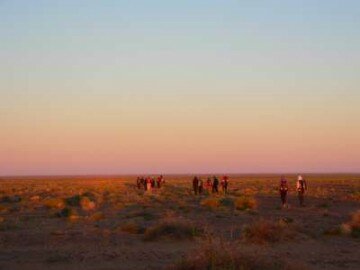 This last photograph was taken as we walked out one morning into the dawn. I looked around and smelled the rich moist air, so different from the Sahara, so much more complex and wild – so very Australian. The enormous desert sky glowed with the passionate reds that make my heart swell, and my mind forget any blister. The children chattered around me, and one of them took my hand silently, and we walked awhile behind the others.
I thought to myself: if being able to do this is what ‘adventuring’ gave me, then I will be forever grateful.
And I am.
Thankyou to Chris Cowled for the photographs, and the brave and beautiful teenagers on the walk. All my love to you as you journey through life.
November 18th, 2010 08:43am Paula
I am ever hesitant of writing about new dreams and plans, since the last few years have served up a number of lessons in things not working quite as planned. But sometimes I can’t help myself.
For the last year I have been working on an historical fiction project set in Napoleonic era Spain. Recently, in the name of research, I spent a weekend doing something I could never have imagined – I went to a re-enactment weekend, held by the Australian Napoleonic Society (yes, there is such an organisation). It was the most surprisingly fantastic experience I’ve had in ages. I got to hold – and fire – a flintlock rifle, a copy of an original Baker (think Richard Sharpe played by Sean Bean in the wonderful BBC mini series, based on the books by Bernard Cornwall). I was taken through the operation of a Howitzer, and got to see men dressed in authentic replicas of the fabulously sexy rifleman’s uniform of the 95th brigade (green jackets).
I realise it all sounds terribly anoraky, but you can’t imagine how wonderful it was. Anyway – back to the adventure part.
I am hoping (let’s not get all too excited) to do a walk in Spain next year, partly for research, and partly because – well, because it is just there, and I want to. Finances permitting, that is the plan, and frankly – even if finances don’t permit, I will find a way. I am in dire need of a walk. Hopefully I will get the fiction book knocked off, and another walking one – I did say hopefully!
I just read about Marian Keyes, a favourite chick lit author of mine, who is suffering from clinical depression so bad she has been unable to write for over a year now. I adore her books – not least because of the darkness in them – and my heart went out to her in the honest way she communicated about what she is going through. It made me think yet again that fame, fortune, and success are as illusory as they can be fleeting – what matters any of them if you are too deep in the darkness to get out of bed in the morning? I am constantly amazed by the real strength and courage of those who battle mental illness. I have a few people very close to me who have, and continue, to struggle with such demons, and I am in awe of the fact that they are able to get up each morning. It is a sobering thought that the World Health Organisation estimates that within 20 years, mental health will be the biggest health issue we face as a society.
I have always understood the fundamental difference between situational depression – which we all suffer at some point to varying degrees – and deep clinical depression, which is something I know I have no experience of. I can only say that reading of Marian’s struggle today, and the recent experiences of some people close who I admire, made me want to write here that if you are suffering in this way – I wish you all the strength and love in the world to cope.
No amount of walking can match the daily challenge of living with such a black monster.
Next one when I have booked my flights.
September 7th, 2010 01:00am Paula
Apologies for the long absence, and incorrect information. As has been commented on, the Insight program that was scheduled was cancelled due to the election. I am still waiting to find out if it will be re-scheduled.
I had a wonderful walk in central Australia, and was hoping I would have some photos to post up – but am still waiting for them to be sent through from the other people on the trek. It was a great experience, and sheer bliss to be back out in a different Big Empty – an even more beautiful one, dare I say it.
I came back and launched straight into the ski season on Mt Buller, and have just come up for air after a busy season. I am planning to be back in the UK in a few months time as a precursor to the next walk, so stay tuned – I am keeping every detail under wraps until my sandals are on and the pack is full.
ABC radio is replaying my second interview with Richard Fidler this Friday at 11am. Their setting is 702 on the AM dial. He is such a great bloke – it is a good interview because he is so funny and engaging.
I will endeavour to be more scrupulous with updates…
Cheers.
June 16th, 2010 02:39am Paula
I had a great week with the Talking Heads program, the Emerging Writers’ Festival, and another TV invitation – this time for SBS insight program, on July 20th. I am looking forward to that one!
In the meantime, I am heading off next week to Cooper Pedy, where I have been privileged to be invited to walk with a charity called Delhuntie, who focus on working with teenagers who have faced personal challenges in their home lives. We will be walking from Cooper Pedy to William Creek, and back again – about 170km each way. I feel very lucky to have the opportunity to simply go for a walk – all I have to do is carry my own gear every day! Somebody else is cooking, setting up camp – now, THIS is the kind of walking I could get used to.
It is a wonderful thought to be only days away from sleeping in the Big Empty again, and this time in my own country. Fantastic.
In the meantime, I am aware that life will start to move very quickly when I get back – I am working the ski season on Mt Buller again, and then going back to the UK when I finish the winter. I have a lot of ideas in the pipeline, and yet again, as if I am at the beginning of my journey, the UK seems the best place to organise them all from.
When I post again, I hope I will have some photos to show you of the desert here in beautiful Australia, and some new stories to tell. And in the meantime – I wish you all well, and hope you are having adventures of your own.
May 24th, 2010 03:30am Paula
Well, I am very much looking forward to watching the Talking Heads episode this evening with Peter Thompson. I have not yet seen a final cut, so it will be as much an experience for me as anyone else! I have bitten a few nails hoping that I haven’t put my foot in it too much, with my customary frankness (that is the polite way of putting it).
Thanks to all of you who have contacted me to wish me luck. If I don’t answer my phone this evening it is because I am on the other one!
Cheers
Paula
May 18th, 2010 02:43am Paula
I will be appearing on the ABC in Australia this coming Monday, 24th May, at 6.30pm on the Talking Heads program.
Peter Thompson is the interviewer. I’ve not yet seen the final product, but in essence the program covers my early life and family background (they’re game, aren’t they??) and on into the Sahara walk and where I am currently at.
I found out today that Niger is moving closer to democratic rule again. Whilst things are highly dodgy in the North of the country, as they always were, it does look slightly more positive. I hate these bits of news as much as I love them – just when I give up on the whole thing, news arrives that makes my heart jump again. I can’t let it go, no matter how much I would sometimes like to.
Anyway, I hope you can all tune in.
Cheers
Previous Posts


 handmade silver jewellery, and flat soled leather babouche shoes to walk comfortably up the steep stone alleyways. The smell of dope hangs permanently in the air, and everyone seems to have a dog. Walking through the Albaicin is a constant exercise in looking down – there is dog crap every metre. Strange, though, how it doesn’t impinge on the charm of the place. In the same moment that you step over crap, a pomegranate tree hangs over a whitewashed wall, and charms you completely with its delicate leaves and sensual red fruit.


 about. I walked past the flamenco bars, all shut at that time of day, and could understand how it would be a cavalcade of hustle at night. Whilst the bars of the Sacromonte gave birth to the first incarnations of flamenco in the late eighteenth century, an authentic zambra is no longer something an unsuspecting tourist can wander into. The bars now come prettily packaged and postered, and tour guides lead groups through the winding streets to bars where they are treated to overpriced stage shows. Like anything ‘culturally typical’, in the last twenty years the area has been exploited and homogenised into irrelevance.


