Tidjikja
December 7th, 2006
Ok, I am preempting this post with an apology. Yet again the photos won't upload due to a bad connection, so this will have to wait for comms in one month. (edit: you'll see a few made it though - cyberhobo) Now read on to get the details…
I am in the thriving metropolis of Tidjikja, working on my lovely new laptop; and since I am at leisure for a couple of days, I have time to fill you in properly about the walk, sat comm issues, etc. Unfortunately whilst I have a laptop, my satellite connection was also broken in the fall from the camel saga, and a replacement won't be with me for another three weeks - hence the lack of communication and poor quality images (assuming there are any at all) on the site. I have found this break in communications immensely frustrating, but as there is little I can do about it but wait, I shall in the meantime attempt to give you a rather more comprehensive and laidback view of the walk so far, rather than the somewhat harried and tense posting from Atar.
Firstly, I have just had a great two weeks, through 400km of the most dramatic, remote (and difficult) desert terrain I have ever seen. I am here in Tidjikja (if you find it difficult to say don't worry - I still have to think about the spelling, and I've been walking to it for a fortnight) for three days, solely for communication purposes - but I have to admit that I am grateful for the chance to recuperate a little before the next push to 'Aayoun el Atrouss, 500km away. And when I get there - I am two thirds of the way to Tombuctou!
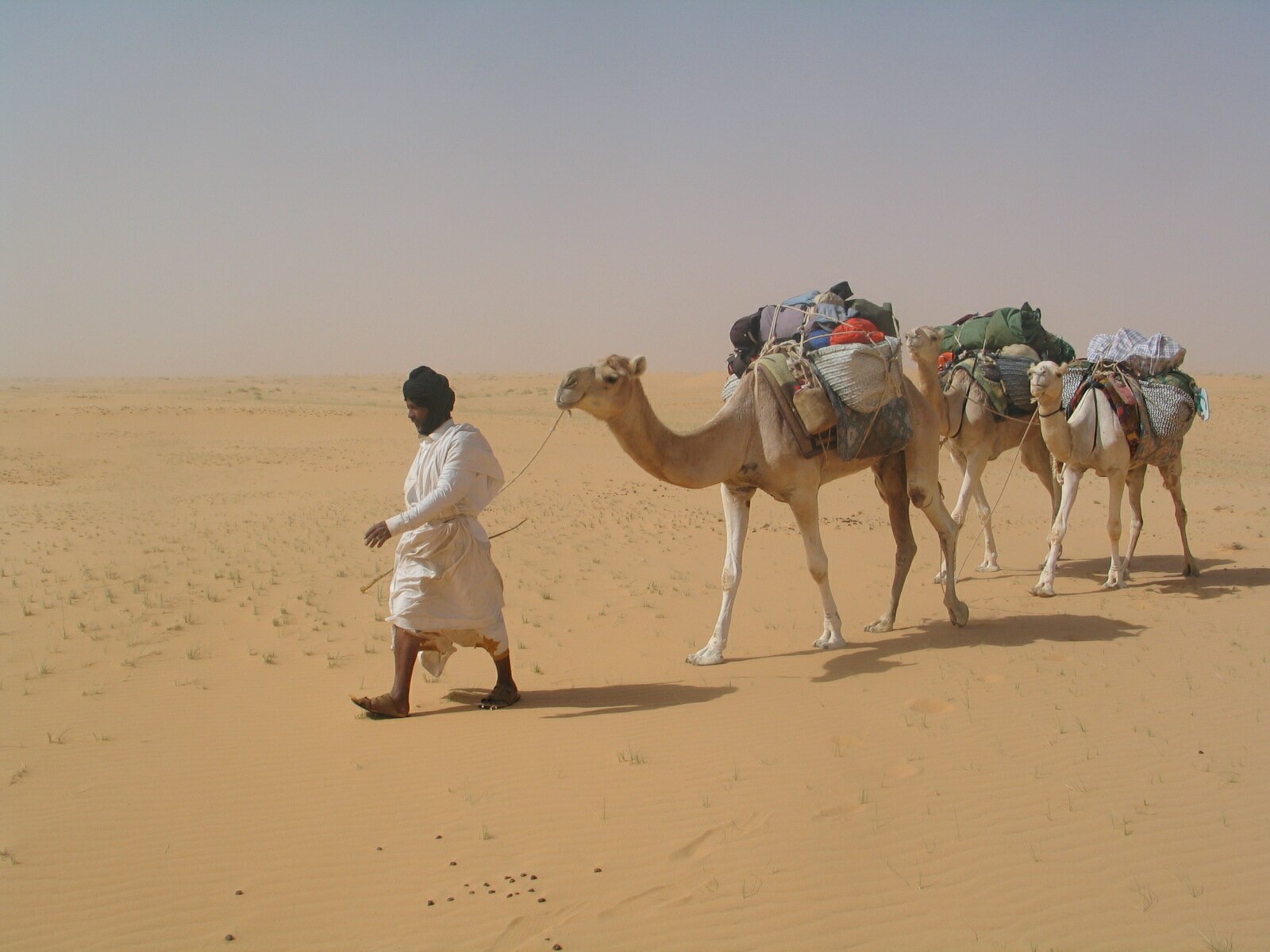 This is Khabuz. Or - is it a bird, is it a plane, is it the fastest bloody thing you have ever seen on two legs racing up a sand dune, Superman Khabuz? From the diabolically disastrous Harraba, I have just spent a fortnight in the company of a man who has not only spent the best part of his life in the elite part of the military, but has also mapped the entire country of Mauritania - including the most remote parts of the Sahara, where he has spent months wandering in order to make topographical representations; co-ordinated some of the most challenging expeditions made by film crews into the dangerous frontier territory with Mali; and has forgotten more than most ever learn about camel handling. After spending rather too many tea sessions with men who are keen to tell me how brilliant they are, I was a little wary of Khabuz at first, especially when he chose to tell me that others call him the King of the Desert (it is seriously difficult for an Aussie to keep a straight face when someone insists on telling you how utterly brilliant they are - but I learned long ago that is part of Arabic culture, and you either learn to recognise the ones who are serious, and disregard the rest, or get driven nuts. If you listened to them all you would think that every Arabic country is populated with the most virile, indestructible, wise, learned, and noble men the world has to offer - and believe you me, NOTHING could be further from the reality). Fortunately for me, Khabuz was acutally the real deal.
Things didn't kick off too well, though. Jean, the French tourist who had initially found Khabuz (through a recommendation by a fellow traveller) had offered to pay for his services for the entire stage to Tidjikja. The deal was that due to the fact that we would be using my camels, and that as I was also available in the capacity of cook and fellow chamellier, Khabuz had dropped his price substantially; I would pay for food only. Unfortunately, after two days walking, Jean decided that he simply wouldn't make it to Tidjikja - he was run down and running a fever, and wasn't prepared to enter the remote territory of the big dunes feeling vulnerable. There is always a final point before you enter no-mans land at which it is possible to disembark, so to speak; and so at the camp of some nomads from Khabuz's tribe, he located another chamellier who was prepared to take Jean for a tourist circuit. The problem, of course, was that Jean wanted Khabuz - this was the man after all that had been recommended as the guide extraordinaire. But Khabuz - bless him - said he had a duty to see me through to the other side; that there was no way he would let me either walk it alone, or trust me with another guide. I guess I took this with a bit of a grain of salt at the time - it isn't the first time I have been told I am heading into the most difficult bit of desert I will ever see - and also felt pretty upset that I would have to fork out money again. But after the long hold up in Atar, I wasn't prepared to muck about and waste more time, and even after two days I could tell that he seriously knew what he was doing with the camels. What he did next helped make my decision.
When I left Nouadhibou, it was with three camels - two white and one brown. I do believe that I have previously mentioned the somewhat mentally challenged state of the brown one, but I shall go into a little more detail before I tell the story of it's fate. My two white camels I took to immediately. One is huge and tall, and extremely bolshy; it grumbles and you have to get very swiftly out of the way of it's teeth frequently, but it is generally good, and walks like a champion. This is the official Utopia Insurance camel - the staff at the company are going to vote for a name for it - so I am waiting in anticipation for the naming process to reach completion so that I can start calling it something other than Bolshy sod. The second white camel I have called Zain, "beautiful" in Arabic, because he is just so calm, placid, strong and uncomplaining. He has a good education, Khabuz tells me. But the third…oh, sweet Lord, the third was a sodding nightmare from day one. Oddly enough - and I do not say this to sound like the Arabic men I earlier was so disparaging about - I really wasn't keen on the brown one from day one. He didn't look broad in the chest to me, and although tall, I remembered very clearly MBarak telling me that for long voyages, always go for the small but solid types. I let Habib override me on this one and it is a lesson I won't forget in a hurry. It is the last time I let someone talk me into something I know is a bad idea. Khabuz took one look at the brown camel - "Hammad Kassool", I had christened him, meaning "lazy brown" - and said "that is a bad camel. You need to get rid of him." After dragging the lazy sod over five hundred km, chasing it into sand dunes, and putting up with it squealing in protest at even the lightest of loads, I was a bit over being told how bad this camel was - I knew damn well it was a sod. The problem was that for the entire distance between Nouadhibou and Atar I simply couldn't find a replacement, and it wasn't for lack of trying, I tell you. So I smiled and nodded and said that yes, I knew he was a shit, and - hey - I would love to find a solution.
So, back to this camp and Jean departing. Khabuz whispered that there was a nomad who was prepared to take Hammad Kassool off my hands and exchange him, free of charge, with his own camel - providing Hammad Kassool would accept the saddle for riding. I looked at the little white thing that Khabuz was suggesting, and felt pretty nervous - beside my three camels it seemed tiny, and I wondered if I was being seriously done out of cash. Khabuz told me that the only reason the nomad was prepared to exchange was because he knew the territory ahead, and was a friend of Khabuz's, and was happy to help out, providing Khabuz donated a little present next time he visited; he said that the exchange was far better on my part than the other guy's. Unfortunately, after having first hand experience of corruption on every level since my entire desert walk began, I took this little story with a very large grain of salt. But even a fool could see how well trained this camel was. And the big thing that I couldn't get away from was the great whacking chest and shoulders he had on him; when Khabuz told me that this was one tough, strong little camel, I was inclined to believe him. And when I finally watched Hammad Kassool throwing his customary whingeing tantrum as the nomads saddled him, I couldn't help but feel that anything would be better than that useless bit of meat. And so Hammad Kassool went off to a life of being ridden about by nomads, and I found myself with Beiyel (please excuse the spelling, Arabic speakers, but I need to make it pronounceable for everyone else - Beiyel means the little white one).
Less than a day later, I was utterly grateful for the change - Beiyel is as tough as Khabuz promised, very well educated, and calm as custard. I watched him gamely trotting along to keep up with the other two rather larger fellows, carrying more than both of them, and then calmly plodding off to eat as soon as we stopped - the others need a little siesta before they can feed, but this one is used to working hard and getting the feed in when he can - and thought: "oh, thank god." I suddenly had a team of camels that work together, and that I can handle.
The first day we were alone, I explained to Khabuz that although it is not my aim to walk alone, I want to be in a position where if needs be, I can handle the camels and baggage by myself; the problems on the way to Atar brought home to me how vital this is, whether as a backup if something happens to my guide, or in the case that I find myself with another Harraba. For the first time since I began this walk - I have had this discussion with so many blokes, MBarak included - he actually nodded in agreement, took me seriously, and told me that he already knew I could do it if I needed to, and that his job on this leg was to teach me the bits I didn't know. I could have wept with relief. After so many people telling me not to be stupid, that I could never manage alone, it was bliss to find someone who understood that it is not my choice to walk alone - it is hard enough with two - but that I need to be prepared to do so if the situation arises. He also told me that he has never heard of anyone, male or female, making a trip of the same length as I am doing - and that no woman to his knowledge has traversed even the Sahara of Mauritania, without a partner. That chuffed me up a bit.
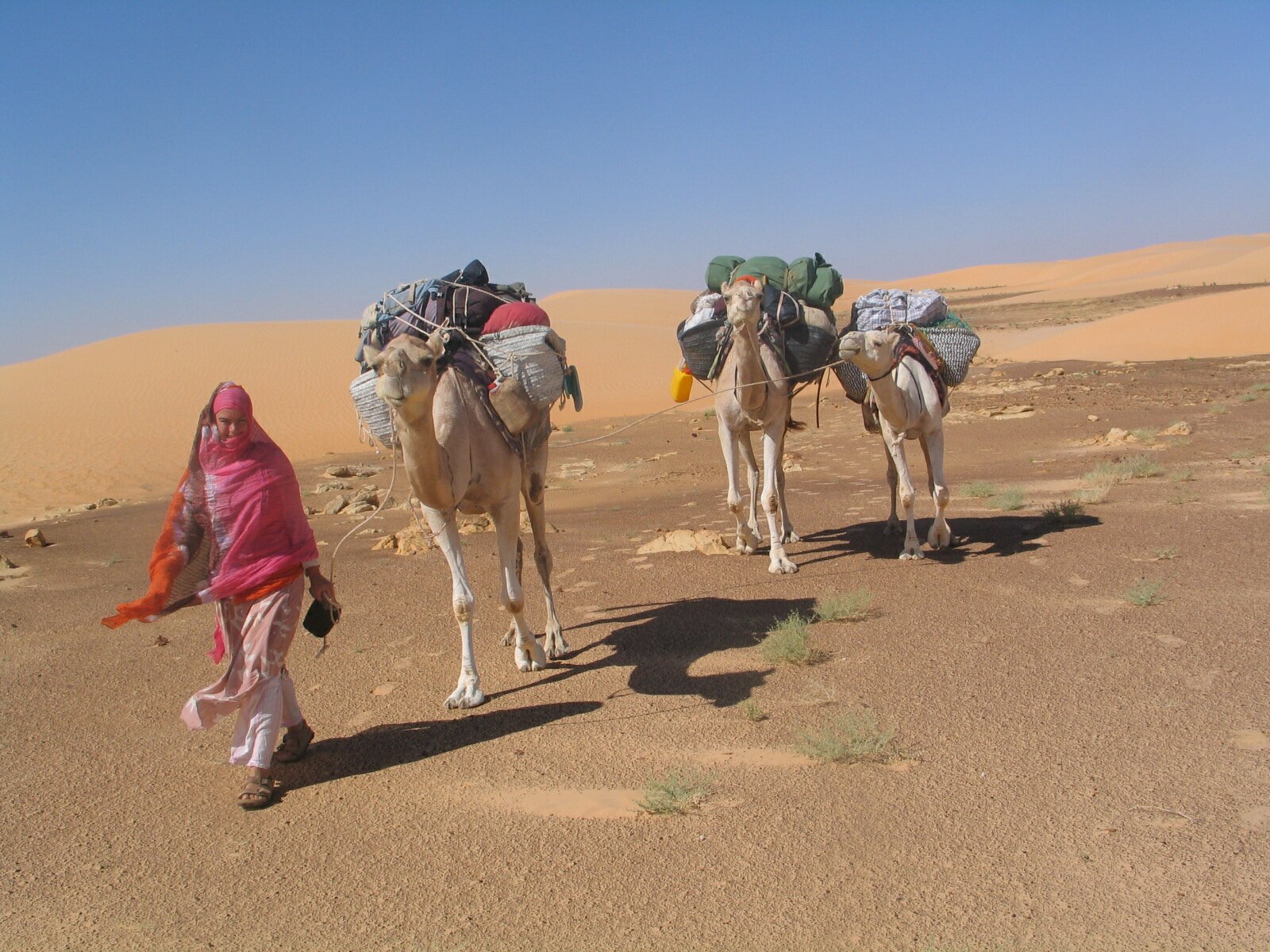 And then we were into it, and Khabuz seriously came into his own. There is a rough piste track between Atar and Tidjikja, that tourists in vehicles can take - although pretty much always with a guide. But we were far off that track, straight into country that Khabuz has walked and mapped, but that I rather suspect very few others have ventured to explore. To give you some indication - it takes three to four days in a car to traverse the significantly easier piste route. Three days, for 400km. That is slow going. It is never easy doing 25-30km a day, no matter how many times you have done it. But when that distance is a continual haul of up and down mountainous dunes, or through silty oueds, or across rocky ravines - everything but hard flat ground, in fact - it is particularly difficult. And I can only say that my respect for Khabuz increased daily when I watched him quite literally trot through the toughest of terrotiry, his feet barely skimming the ground; it was with amazement every day that I looked at the GPS and realised that we had done at least the 25-30 (since the GPS only gives the bird's eye view, which means it misses an awful lot of km in our case) in substantially less time than I am used to. I normally walk between 5-6 km an hour. Khabuz does 8. We settled on a compromise of about 7; even so, it is the fastest I have ever moved, for an extended period of time, on foot. He wasn't an early riser, which really got to me the first few days - even though the season has changed to cold now, I hate missing my early hour of pre-dawn walking, when the world is calm and cool. But after a few days I realised that we could leave at 9, a good two hours after dawn, and still manage to cover my normal distance by 2, leaving plenty of time for the camels to feed. The only time he stopped was for a quick water and cigarette break, about three hours into each day - for the rest it was just flat out and into it. Even more remarkably, when he noticed me marking our camp on the map with my GPS, he told me the co-ordinates of where we were without looking - and he was spot on. Some days into the walk, just to test him, I asked to pick the camp; I walked a bit further than normal and challenged him on the co-ordinates. He got them dead on. He seriously knows this country.
But, oh, the desert was so beautiful. No matter how tough dune walking is, or how hard it is to find good feed for the camels, I doubt I could ever tire of cresting one of those peaks and looking out to an unending sea of sculptured mounds, the sprays of sand whipping up from their walls glistening in the hard sun. However cliched or over exploited photographically, huge dune seas are a thing of immense, tranquil beauty, and I can never regard them without feeling awed and touched, content somehow inside. There are many facets of the desert that I love; every different landscape has a unique, striking beauty, and sometimes I think that it is sad that it is only the dunes we associate with the Sahara. But when I see them laid out before me like some ancient mythological fantasy, I understand exactly why they are the granddaddy of all desert vistas, and feel abjectly grateful to be able to walk amongst them.
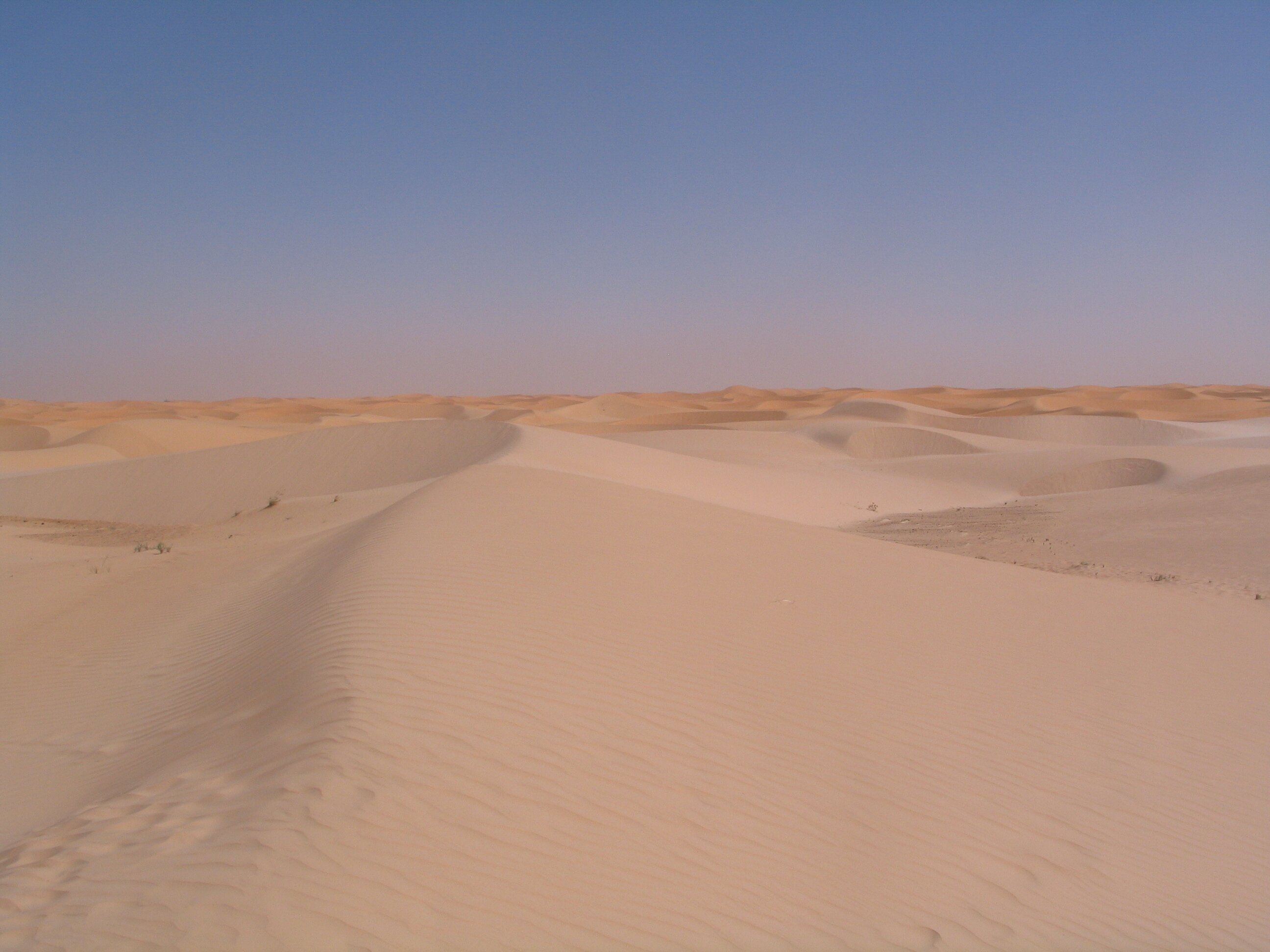 We came to one part where the entire colour of the dunes changed, in one clear delineation; one moment brilliant white, the next, a deep flaming orange. I know there must be some complex explanation for that phenomenon, but to me it simply looked as if God had run out of one colour sand and opened another box of a slightly different hue. Just wonderful. And in all that tough walking, the camels climbing up and stumbling down and struggling through two feet of shifting sand, not one bit of baggage moved an inch, and we had not a single problem with any of the camels. By the fourth day Khabuz was getting me to pack them all, just supervising and showing me where I could do things better; at night when he went to track the camels he took me with him, and made me work with ropes and do all the things that other guides had conniptions over every time. Of course I have hobbled them and roped them, many times, but it was brilliant to be with someone who insisted on me actually doing it every time, and correcting me when I made a mistake, and explaining to me why things are done a certain way. It was empowering and exciting, and even when he woke me, after one of our longest days ever, in the middle of the night because a herd of camels were nearby and he wanted to show me what I should do, I leapt happily out of bed and followed him, so grateful to be granted the gift of knowledge.
Khabuz speaks French as well - something which really helped, both with my Arabic and just for general conversation. It was bliss to have a guide I could communicate with directly, for once.
In the middle of that walk we came - somewhat ironically - upon this gorgeous lake, surrounded by a palmeraie and gardens. The camels drank their fill and I actually got to have a real wash, which was particularly exciting. I have never seen a lake in the desert before - it was a real sight.
So whilst I am rambling on about Khabuz, I will use this walk also to tell you a little about life here in Mauritania, and how I find it so very different to that in Morocco. Some good, and, I guess, some not so good. Again, if you are an expert on this territory, please accept that this commentary is only my observations, and not meant to be authoritive or definitive.
Mauritania is an Islamic Republic that is for the most part populated by Arabs of the same origin as the Saharawi in Morocco - descendents of the Beni Hassan tribe, which came to Western Africa from Yemen in the 11th century. The Beni Hassan conquered and over centuries assimilated with local Berber tribes, producing the race now known to history as the Moors; but here in Mauritania, and indeed amongst all Saharawi, there is little mention made of the racial assimilation, and much made instead of pure Arab heritage. But despite the fact that I am in essence walking with the same culture that I lived amongst in Morocco and the Western Sahara, in many ways I feel as though I am in a new world. Perhaps the first thing I noticed was food (yes, we all know that is my undying obsession); whereas Morocco is almost obsessed with good eating - to a point which could be a bit annoying when you just wanted to eat and sleep, and every meal needed to be a production - Mauritania goes for functional. There is none of the elaborate preparation, or million spices, that characterises Moroccan food; in the tents here it is rice, pasta, meat if you're doing well, and the odd potato, with a hint of salt. Dates are eaten only just before a meal, rather than as a snack. Breakfast doesn't really exist; we drink a maize powder mixed with sugar and water, originating from Spain, called Gofiya. I live on this stuff - Khabuz joked that my day basically starts with "Bonjour, Gofiya", and he's not kidding. I love it. Tea is always - \i always\i0 - prepared three times, whether it is morning or not - this is something that took me a while to get used to, as MBarak used to make one big pot in the morning, and reserve the whole three pot ritual for after we finished. It does my head in a bit to wait and stoke the fire for three brews, but that's the way of it. Breakfast is tea, gofiya, and a couple of biscuits; my Moroccan nuts ran out long ago, and the Mauritanian equivalent is not worth eating. When we stop walking, it is more tea, gofiya and biscuits; the only meal is the rice and tinned fish, or meat, plate at night. I have to say though that after months of endless tajines, and having to make bread every day, I relish being able to eat a simple carbohydrate meal every night. And I don't miss the bread making process.
In the tents too, here, everyone eats together. This was one of the hugest changes for me; I am so accustomed to the ritual of the women's tent that I felt quite huffy when I first realised that the women aren't really into all the lovely ritualistic girly stuff I adored in Morocco. They are tougher here, and far more respected; they eat with the men, they are totally at home in the male domain, and there is none of the seperate lives thing that there was in Morocco. I have begun to realise how bourgeois nomadic culture in Morocco is; a little like America in the fifties, it is finding it's way into a more modern future by making gender roles even more pronounced than they once perhaps were. Here, where life is hard - much harder than Morocco - and people are working to survive, there is far less adherence to strict standards of dress or conduct. The women wear their melekhvas often over naked bodies, breasts potruding when they bend over; they are utterly unconcerned with the body coverage I am used to. They laugh at me in my layers, but I am used to the Moroccan way of doing things, and feel uneasy dresed as they are. My clothes also make sense for walking, which is more important for me. They are also nowhere near as obsessed with hygiene; due to water shortages, I guess, there are no hammams (aaarrrrggghhh!!!) in the villages, and the whole cosmetics ritual has gone out of the window. I find the culture a lot rougher. In some ways I like it, and in others I don't. I miss the solidarity and refuge of the women's tents; I find the women here harder and more unfriendly, less concerned with showing hospitality and more interested in what I can give them, something a Saharawi woman in Morocco would be horrified by.
Conversely, I find the men (let's forget Harraba for a moment) absolutely great - truly Islamic, they take their religion really seriously, they don't go to mosque and then the bar afterwards, and they are respectful and kind towards women. The male hypocrisy in so-called "liberal" muslim countries like Morocco and Egypt can be absolutely painful; whilst the men drink, smoke, and commit every sin under the sun, they expect their wives to be paragons of virtue, and are immensely judgemental. Here the men really are Muslims; Mauritania is proud of it's status as an Islamic republic, and it seems to me that it's citizens adhere to a high moral code. Harraba aside, I have experienced none of the incessant harassment that characterised my time in Moroccan towns (I totally exempt desert dwellers from that generalisation, the nomads were ever kind and respectful) in towns or cities here. I find the men polite, respectful, on the whole well educated, and genuinely interesting. I can relax and have a conversation and feel quite at ease, and for me this is something to really treasure; it also makes it easier for me to accept my melekhva and cultural adherence, when those around me have so much obvious respect for it. SInce Khabuz is very modern and used to tourists, he told me from the outset that I could leave off my melekhva if I wanted, it didn't offend him. I didn't, although it was nice to be able to let it slip off my head when it was hot! But one evening a nomad arrived unexpectedly in our camp - and I don't think he realised I was there until he was right in the middle of it. I had just taken melekhva off to go to bed, but was still where he could see me, and where it was necessary for him to greet me; he kept his head averted, eyes downcast, and did not address me until I had re-robed, at which point he looked up and smiled shyly and greeted me officially. I was really touched by that level of respect.
I also love the prayer ritual here. Although every mosque in Morocco blares out the muezzin five times a day, I wasn't so conscious of individuals praying; here, the meuzzin is subdued and melodic, but whether in the middle of the desert or town, everyone prays. And it was lovely to hear Khabuz, who has a beautiful voice and is a scholar of the Q'ran, sing the verses with passion and love, first thing in the morning and at night. There is also something undeniably romantic about seeing robed men gather together amidst dunes, in the glow of the dying sun, to pray; it never fails to touch me. I like very much the honesty of Islam here, and have a great deal of respect for it. I find the culture of demanding presents hard to take, however, after the endless generosity of Moroccans. I understand that too many tourists give into it freely, but it gives me the absolute pip to be greeted by a grown woman (children I can understand) and immediately asked for a cadeau. Most nomadic women will instead offer a present - a stone artefact, or bangle - and then, perhaps, ask for something they need, like shoes. This I can understand, and always give something in return. But the blatant grabbing of some - especially close to the tourist routes - is pretty unpleasant. I am just grateful that I am on foot, with obviously not a lot to take. I would hate to be in a 4wd and constantly in places where the beggars gather.
In an odd way, although Morocco prides itself on liberality, I feel far more free here; as if when everyone understands the rules, there is no insistence that you adhere to the little things. For example, if a woman smokes in public in Morocco, she is obviously deviant (prostitute and tourist equate to roughly the same thing in Morocco). Here, everyone knows that there is no way a woman would have sexual relations outside of marriage - so who cares if she smokes? I also love the marriage view - Khabuz has been married 19 (!) times. It is perfectly acceptable for a woman to do the same. So you can marry today and divorce tomorrow…which kind of negates the need for sex before marriage anyway! It all just seems a lot more laid back, and minus the tense zig zags that characterised inter gender relations in Morocco. The particular region I am in, around Tidjikja, Chinguetti, and Oualata, is the cradle of Mauritanian heritage and study. There are ancient libraries and museums in the towns, and literature and history are highly prized and cherished. Tomorrow I am being taken, by a friend of Khabuz, to see the ancient manuscripts in the library here. I am looking forward to it. I enjoy hearing the poetry and stories of the region, and in this sense Mauritania has a far more immediate association with it's Arabic heritage than Saharawi culture in Morocco - not suprising, considering that the Saharawi in Morocco are marginalised and discriminated against by the rest of the population.Saharawi culture in Morocco has become more of a protest culture, politically driven; here it is simply the way of life.
So. Enough philosophizing and back to the walk.
In the last day before we arrived here, we found a brilliant old nomad - another Mohammed - from a good tribe originating from Chinguetti. We got talking, and the upshot is that my camels are with him, and he has signed a contract with me to walk me to 'Aayoun el Atrouss. I feel really good about this one, as he walked with us for a day, Khabuz explained everything about our routine and my walk, and he understands what I am doing and how I do it. He is very old, which I also like, and a good smiley man who meets my eye. And he's great with the camels. This stretch is supposedly easier than the last; I hope so, as I have a bit of a tough push then to Tombuctou.
The great news is that after a really rocky beginning, I feel as though I am back on track and functioning well. I have to laugh - after a lifetime of struggling with weight issues, I have dropped so much so fast that when I got here and they said it was possible to eat three meals a day in the hotel, I immediately said "yep - bring it on, and sod the cost" - and have been stuffing my face since. I figure that there is a long way to go until this walk is finished, and at the rate I am going, I will be nothing but a stick figure by the time I get there. These rest stops are my refuelling zones now. Eat, sleep, write, and have a (cold) shower - that is my sole agenda until departure. The lack of communications equipment means I am so severely behind work wise that I barely know where to begin. I am just hoping that this connection allows me to upload pictures at last - it has been so annoying to be walking and not able to share the country along the way.
The emails, comments, and support from all of you has been wonderful. Lioslath, I really appreciate you continuing to follow the site, and when I mentioned you to Habib he remembered you well. I will get to your lovely place in the Todra gorge one of these days! Joanne, I hope this one leaves you a little calmer, and you can stop mother henning (save it for when I get back and eat your fridge dry). To Dad, Mum, Lisa, and Graeme - thankyou. It is just awesome having you at the end of a (bad) phone line. You have worked tirelessly to make all this happen and I am incredibly grateful for your love and support. To James Pickering at Utopia travel insurance - thankyou for everything, you guys have come through like champions on the back of very little, and I am really grateful. I am looking forward to getting my camel named! To Paul Glasson at TRC communications, you have been truly brilliant putting up with phone calls from every member of my family and others besides. Thanks for all the help and I hope that the new stuff stays put on the camel!
Entry Filed under: trekking
7 Comments Add your own
1. Emma Gray | December 9th, 2006 at 3:23 am
Hey Aunty Paula,
how are you going, it’s great that u finally have communication to us and u can update your website. I’d love to hear from you soon.
Love Emma
2. bev walshe | December 9th, 2006 at 7:07 am
Lovely to hear the news.Sorry I missed you. Hav e emailed you on Gmail as yahoo is telling me your site has blacklisted me. . I need to pass on some info. you may need. Wes or Lisa will try to send it on my behalf if the GMail has not worked. Frantastic photos. Keep it up - bestdwishes to you and your new guide. I do hope you nhave a happy time. Will have to read your blog again — was i mistaken or are you getting different camels again? Little White One looks absolutely sweet,, trotting along beside the big guys. Cheers for now and lots of love, Mum.
3. clint | December 10th, 2006 at 1:50 am
Ok! you have landed on your feet again. Your second post is just what I have come to expect… wonderfull and insightful. You have managed to make your own good luck again, a skill you seem to have. I am looking forward to all future posts.
4. tanya | December 11th, 2006 at 6:56 pm
Thank you Paula! You are such a fantastic writer. Sooo good to see you and the camels smiling- great pictures. All the best for the next leg. Tanya xx
5. Joanne | December 12th, 2006 at 5:12 pm
OK, clucking over. Photos would be great but just diving into the text gets the imagination going. Good stuff. Delighted its all going well and you have a good guide at your side again. Love from London x
6. tom | December 25th, 2006 at 8:04 pm
The holidays may well be over by the time you read this, but Merry Christmas anyway!
I’m linking to pretty much every post these days, and not out of Christian charity … it’s because they’re all so amazing.
7. caro | January 20th, 2007 at 9:08 am
hi paula
i’ve been following your trip and am hooked ever since reading the full moon and the one glass story - you must have developed the patience of a saint after dealing with so much. I would seriously love to be in the wilderness camping out every night and walking from place to place each day. Keep up the good walk.
caro.
Leave a Comment
Some HTML allowed:
<a href="" title=""> <abbr title=""> <acronym title=""> <b> <blockquote cite=""> <code> <em> <i> <strike> <strong>
Trackback this post | Subscribe to the comments via RSS Feed